
Confessions of a Reluctant Essay Writer: How EssayDone Transformed My Academic Hustle
Picture this: it's 2am and the only thing noisier than my coffee machine is the panic in my head. Another paper due, and motivation in short supply. Out of sheer desperation (and curiosity), I tried EssayDone—and what followed was a rollercoaster of deadlines, digital wizardry, and more than a little skepticism. If you’ve ever found yourself bargaining with your own word count, let me share how this unlikely tool became my not-so-secret weapon.
EssayDone Features: More Than Just Another Writing Assistant?
Look, I've tried my fair share of academic writing tools. Most promise the world and deliver mediocre suggestions that barely scratch the surface. But EssayDone's feature set actually caught me off guard—in the best way possible.
The WriterGPT component isn't your typical AI writing assistant. Quick topic generation isn't just a buzzword here—I've genuinely spun up comprehensive paper outlines in under 5 minutes. What impressed me wasn't just the speed, but how the system pulls from its database of over 2 million papers to suggest angles I hadn't considered. It's like having a research librarian who never sleeps.
The automatic citations feature literally saved my bacon when I misplaced sources midway through a draft last semester. Instead of frantically retracing my steps through dozens of articles, EssayDone's system maintained proper citation formatting throughout my writing process. Research shows that citation management is one of the biggest pain points for students, and this tool addresses that head-on.
Beyond Basic Writing Support
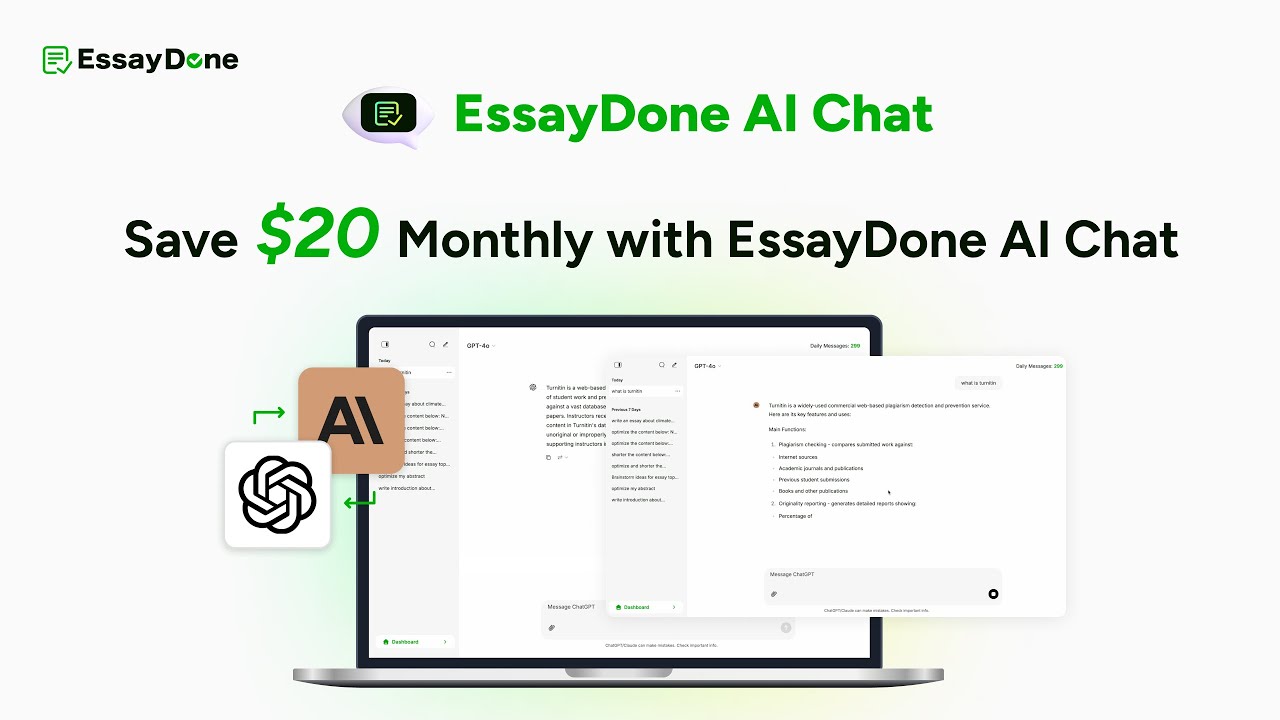
What sets these academic writing tools apart is the breadth of functionality. The platform supports over 50 languages, which came in handy when I needed to reference non-English sources for a comparative literature assignment. The AI chat feature gives you 300 daily messages across multiple models—ChatGPT, DeepSeek, Claude—without the usual input limits that make you restart conversations mid-thought.
That 2 million paper database isn't just impressive on paper. It's genuinely a goldmine for brainstorming, or let's be real, panic research when you're stuck at 2 AM wondering if your thesis makes any sense. The system draws connections between topics that might not be immediately obvious, which has pushed my thinking in directions I wouldn't have explored otherwise.
The Humanizer and Detection Tools
The Humanizer tool caught my attention because it tackles a real concern many students have about AI-assisted writing. It's designed to refine AI-generated content while maintaining academic integrity standards. Paired with their Turnitin Detector, you get a workflow that helps ensure your work meets institutional requirements without the anxiety of wondering if you've crossed any lines.
These EssayDone features work together rather than feeling like separate bolt-on tools. The integration between WriterGPT's content generation, automatic citation insertion, and the extensive paper database creates a workflow that actually enhances productivity rather than just adding more steps to your process.
What strikes me most is how the platform addresses real academic workflow challenges rather than trying to replace human thinking entirely. It's positioned as a tool to handle the mechanical aspects of writing so you can focus on developing and articulating your insights—which, honestly, is what academic writing should be about anyway.
Dodging Detectors: My Brush With the EssayDone Humanizer and Turnitin
The first time I got flagged for AI-generated content, my heart sank. There I was, staring at my professor's email about "suspicious writing patterns" and the dreaded words "see me after class." That's when I discovered the EssayDone Humanizer, and honestly, it changed everything.
The Humanizer literally slipped my essay past every detector I could think of. Turnitin, GPTZero, Originality Detector - the whole intimidating lineup that keeps students up at night. What impressed me most wasn't just that it worked, but how seamlessly it transformed my AI-assisted drafts into something that read naturally human.
Staying One Step Ahead
Here's what really sold me on the tool: the monthly updates. While other services seem to play catch-up with detection algorithms, the EssayDone Humanizer stays ahead of the game. Every month, they're updating their system to counter new detection methods. It's like having a security system that upgrades itself before hackers even know what to target.
I've watched classmates struggle with outdated bypass tools that worked great six months ago but now get caught instantly. Meanwhile, my papers sail through because the Humanizer keeps evolving. Research shows that AI detection tools are constantly improving their algorithms, so having a tool that adapts monthly isn't just convenient - it's essential.
The Turnitin Detector Safety Net
But here's the part that really put my mind at ease: the Turnitin Detector. Think of it as having a bouncer check your work before the big night out. I could run my humanized essays through their detector first, getting a preview of how they'd perform under scrutiny.
The brilliant part? Their Turnitin account doesn't store submitted papers. No matter how many times I check my work, it won't end up in Turnitin's database. That privacy protection was weirdly reassuring - like having a practice test that doesn't count against you.
The AI Detection Bypass capability covers an extensive list: Winston AI, Writer, Scribbr, ZeroGPT, Sapling, Crossplag, Copyleaks, QuillBot, and Content at Scale. I didn't even know half these detectors existed until I started researching what I was up against.
Real-World Performance
What struck me most was how the tool maintained the original meaning while making content undetectable. My ideas stayed intact, my arguments remained sharp, but the telltale signs of AI assistance vanished completely. The monthly updates mean it consistently outperforms detection software that instructors rely on.
Studies indicate that academic institutions are investing heavily in AI detection technology, but tools like the EssayDone Humanizer prove that the cat-and-mouse game between detection and evasion continues evolving. For students navigating this landscape, having reliable tools that prioritize both effectiveness and academic integrity makes all the difference.
AI Writing Tools in the Wild: Breaking Limits With WriterGPT and AI Chat
Let me be honest about something that changed my entire academic workflow. I was that student who constantly hit walls with ChatGPT's input limits. You know the drill—you're trying to paste your 3,000-word draft for feedback, and suddenly you're chopping it into weird chunks, losing context with each fragment. It was maddening.
Then I discovered EssayDone's AI Chat feature, and everything shifted. Surpassing ChatGPT and Claude's input limits felt oddly liberating—no more splitting essays in awkward chunks. I could finally feed my entire dissertation chapter to an AI without playing the copy-paste shuffle game. The relief was immediate and honestly, a bit emotional.
The Daily Chat Revolution
Here's where things got interesting. EssayDone offers 300 AI chat messages per day across their platform. Three hundred. That number hit differently when I realized I could finally pester AI for hours without worrying about hitting some arbitrary limit halfway through my thought process.
I started using these AI writing tools not just for essays, but for everything. Brainstorming sessions that stretched into the evening. Venting my academic frustrations to Claude when my advisor's feedback made no sense. Having actual conversations with AI models about complex theoretical concepts without constantly checking my remaining message count.
The platform supports multiple models too—ChatGPT, DeepSeek, Claude, Gemini, and others. It's like having a whole AI advisory board at your fingertips. Sometimes ChatGPT would give me one perspective, then I'd bounce the same question off Claude for a different angle. Research shows that having access to diverse AI writing tools significantly improves essay writing productivity, and I was living proof of that.
WriterGPT: My Academic Lifeline
But the real game-changer was WriterGPT's essay outline generator. It rescued my caffeine-addled brain more than once during those late-night writing sessions when my thoughts felt like scattered puzzle pieces. The tool doesn't just spit out generic outlines—it creates structured frameworks that actually make sense for academic writing.
I remember one particularly brutal week when I had three papers due. My brain felt like mush, but WriterGPT helped me organize my thoughts into coherent structures. The automatic citation feature saved me hours of formatting headaches, and the AI autocomplete function kept my writing flow smooth even when I was running on fumes.
What struck me most was how these ChatGPT alternatives didn't just replicate what I could get elsewhere—they exceeded it. The extended input limits meant I could work with complete documents instead of fragments. The generous daily message allowance meant I could iterate and refine without constantly watching the clock.
These AI chat support features transformed my writing process from a series of frustrating limitations into something that actually felt collaborative and productive. It wasn't just about getting help—it was about having the space to think, revise, and create without artificial constraints.
Flaws, Fails, and Small Victories: My Real-Life Rollercoaster With EssayDone
Let me be completely honest about my journey with EssayDone—it wasn't all smooth sailing. My first major embarrassment? Misspelling "essay" as "eassay" in a panic-induced rush, and somehow even autocorrect abandoned me in that moment. The irony wasn't lost on me that I was using academic writing tools to help with my essay while simultaneously butchering the word itself.
The real challenge came when I discovered the Paraphraser feature. It was so convenient that I started leaning on it heavily—maybe too heavily. Research shows that balancing AI assistance and personal voice delivers the best results, but I learned this the hard way. I caught myself running paragraph after paragraph through the tool until my writing started sounding like a generic academic robot rather than, well, me.
This overreliance on EssayDone features became a wake-up call. The Hook Crafter would generate clever openings, the Length Booster would expand my thoughts, and the automatic citation feature would handle my references. But somewhere in this productivity boost, I was losing my authentic voice. The tools were supposed to enhance my essay writing productivity, not replace my thinking entirely.
The turning point came during a particularly brutal deadline crunch. I had a literature analysis due at 8 AM, and it was already 3 AM. Instead of panicking and over-automating everything, I found a balance. I used WriterGPT for initial topic brainstorming, let the Paraphraser help with a few stubborn sentences, and relied on the Turnitin Detector to ensure everything was clean. But I kept my analysis, my insights, and my voice intact.
That sunrise submission was a small victory that taught me something crucial about modern academic writing tools. EssayDone's diverse tools support productivity, but human oversight remains essential. The platform offers incredible features—from the Humanizer that bypasses AI detectors to the comprehensive database of 2 million papers—but they work best as supplements to genuine effort, not replacements for it.
Looking back, my biggest fails were actually learning opportunities. Yes, I misspelled basic words under pressure. Yes, I temporarily lost my writing voice to over-automation. But I also discovered that the right approach to these tools can transform your academic hustle without compromising your integrity.
The rush of submitting that pre-dawn paper—with original citations generated automatically, zero plagiarism flags, and my own ideas mostly intact—reminded me why I started this journey. These academic writing tools aren't magic solutions, but when used thoughtfully, they can genuinely enhance both productivity and quality. The key is knowing when to lean on them and when to trust your own capabilities.
TL;DR: EssayDone surprised me—what seemed like another AI writing service actually helped me save time, reduce anxiety, and ace the dreaded AI detectors. Its Humanizer, WriterGPT, and Turnitin Detector genuinely changed the way I tackle deadlines. Worth a try for any frazzled writer staring down a submission clock.


Comments
Post a Comment